
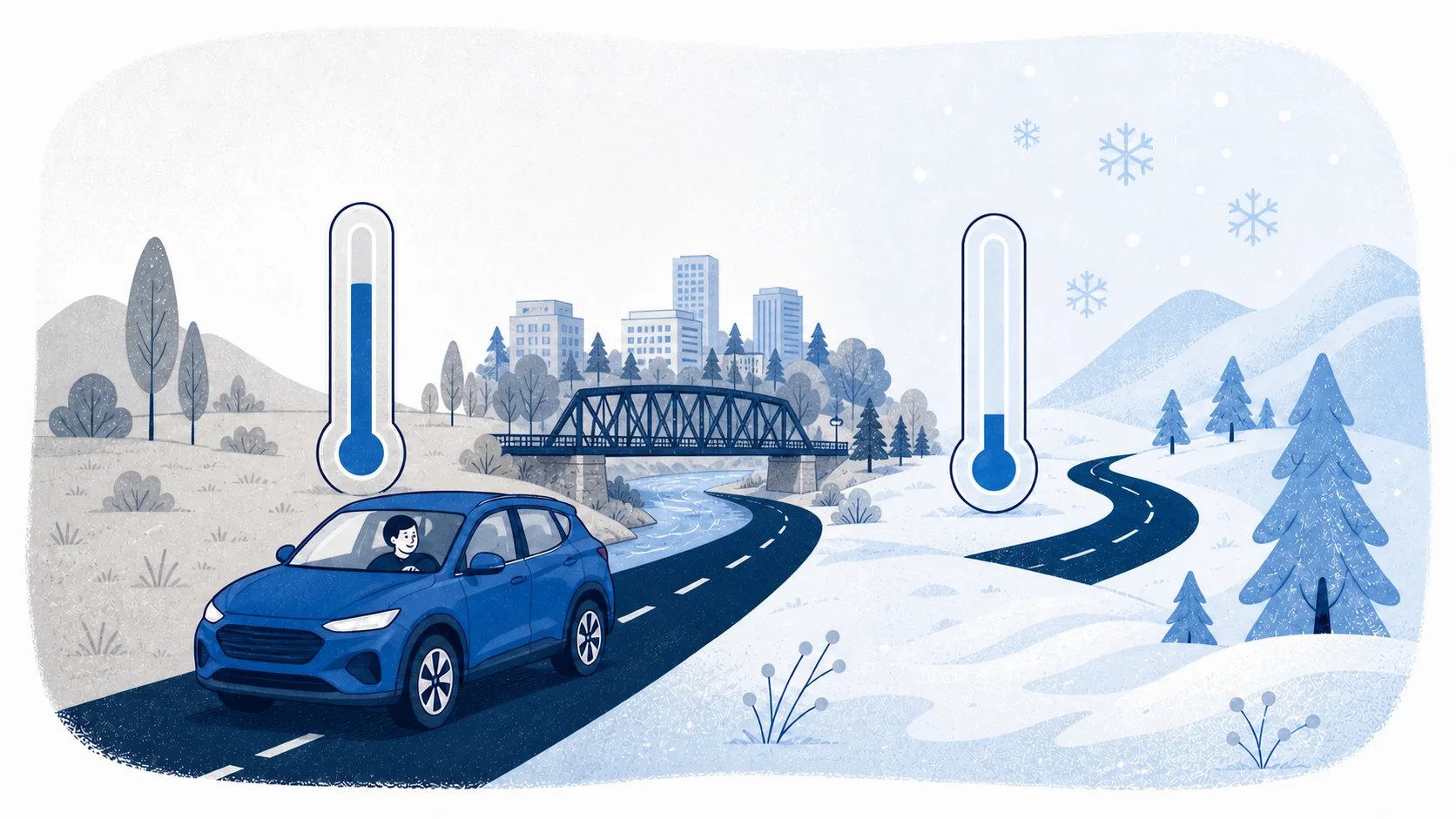
The first snowfall isn’t the signal to switch to winter tires. Temperature is. Winter tire rubber is formulated to stay flexible in the cold, and that compound shift happens around 7°C, whether or not there’s snow on the ground yet.
Why 7°C, not snowfall, is the real trigger
All-season and summer tire compounds start to stiffen once temperatures drop below about 7°C, which reduces grip even on dry, clear pavement. Winter tire compounds are built to stay pliable in that same cold, so they keep contact with the road instead of skating over it. That’s why a dry, cold morning in November can already be a worse time to be on all-seasons than a lightly snowy day in early October.
Timing it for Red Deer
In Red Deer and the rest of Central Alberta, overnight temperatures typically settle below 7°C by mid-to-late October, and stay there through the winter. Watch the forecast rather than the calendar. An early cold snap can arrive sooner some years, and waiting for the first snow often means you’re already driving on hardening rubber during the coldest, riskiest stretch of fall.
Commuters running the QEII between Red Deer and Innisfail, or Highway 11 out toward Sylvan Lake, often feel that cold threshold before in-town drivers do. Open highway loses heat faster than streets closer to town, especially after dark, so a commute along either route can already be below 7°C while it’s still comfortable downtown.
Book your changeover
Seasonal tire changeover in Red Deer
We'll swap your tires and check tread and pressure while you wait, then call +1 (825) 221-3120.
Winter tires vs. all-season tires
All-season tires are a compromise, built to perform adequately across a range of conditions without excelling in any one of them. Winter tires trade that flexibility for dedicated cold-weather grip: softer compound, deeper and more aggressive tread, and sipes designed to bite into snow and ice. On packed snow or an icy morning, that difference shows up directly in stopping distance and control.
| Criterion | Winter tires | All-season tires |
|---|---|---|
| Rubber compound | Stays soft and pliable in the cold | Stiffens once temperatures drop below about 7°C |
| Useful temperature range | Cold weather, roughly below 7°C | Moderate temperatures, roughly above 7°C |
| Grip on ice and packed snow | Deeper, more aggressive tread and sipes designed to bite in | Noticeably less grip; built as a compromise, not a specialist |
| Tread life | Wears faster if run above its ideal temperature range | Wears faster if run below its ideal temperature range |
Alberta doesn’t legally require winter tires, unlike Quebec. Alberta’s own winter driving guidance still recommends running winter or all-weather tires in severe conditions even without a legal mandate, and some insurers offer a discount for running them, so it’s worth a quick call to your provider.
Switching back in spring
Once nights reliably stay above 7°C, typically April in Central Alberta, it’s safe to switch back. A late cold snap can still catch you off guard, so keep an eye on the forecast rather than picking a fixed date.
Getting the changeover done
A proper changeover is also a good time to check tread depth and have the vehicle looked at for anything that turns up during the swap. If the ride has felt off or you notice uneven wear on either set, a wheel alignment check alongside the changeover keeps both sets wearing evenly.
Call +1 (825) 221-3120 to book your seasonal tire changeover at Bay 5, 7880 48 Ave in Red Deer. We’ll swap the tires, check tread and pressure, and flag anything worth addressing before winter sets in.
Frequently asked questions
What temperature should I switch to winter tires?
Right around 7°C, where the two rubber compounds effectively swap which one grips better. Above that line, winter tires wear down faster than necessary; below it, all-season rubber stiffens and loses traction, even in dry conditions. It isn't tied to a specific date, which is why the switch point can land in different weeks from year to year.
Are winter tires required by law in Alberta?
No, Alberta has never made winter tires mandatory, unlike Quebec. That doesn't mean they're not recommended: Alberta's own winter driving guidance still advises running four winter or all-weather tires in severe conditions, and it's a detail some insurers factor into their rates. Confirm directly with your provider rather than assuming a discount applies automatically.
Can I use all-season tires instead of winter tires?
Technically yes, but you're trading away grip precisely when you need it most. All-season tires are engineered as a middle ground, not a cold-weather specialist, and that gap widens once temperatures drop below 7°C or the roads pack down with snow. If your driving is mostly short, low-speed trips around town, the difference matters less than it does on the highway in a Red Deer winter.
When should I switch back to summer or all-season tires?
There's no fixed calendar date. Once overnight lows stop dipping below 7°C for good, which in Red Deer usually falls somewhere in April, it's time. Swapping a week or two early isn't dangerous, just harder on tread life since winter rubber is working outside its ideal range. It's switching late, into a lingering cold snap, that actually costs you grip.
Do winter tires help with fuel economy?
Not directly. Their advantage is traction and shorter stopping distances in cold and snow, not fuel efficiency. Running them past their useful temperature range can actually cost you a bit of fuel economy and tread life, which is one more reason the 7°C threshold works in both directions, not just as a sign to switch to winter tires.
Should I buy a full set of four winter tires or just two?
Four. Two winter tires on one axle create a mismatch in grip between the front and rear, which can make the vehicle harder to control, especially in a slide. A full set keeps handling predictable, and it's part of why a proper changeover treats all four tires as one job rather than two swapped now and two later.