
An electric vehicle does not need an oil change. It still needs a shop. Alberta’s cold, the salt on the highway and the extra weight of a battery pack move the wear somewhere else, and almost all of where it lands is ordinary mechanical work.
What goes away, and what does not
Electric vehicle maintenance loses a real chunk of the traditional list. No engine oil or filter, no spark plugs, no timing belt, no exhaust system, no fuel filter, and on most EVs no multi-speed transmission to service. That is a genuine saving, and it is the part everyone hears about before they buy.
Here is the part they do not hear about. Everything that touches the road stays: tires, brakes, shocks, bushings, steering, wheel alignment. So do the fluids nobody thinks about, because brake fluid still absorbs moisture and the coolant loop that keeps the battery in its temperature window is not a lifetime fill. The 12V battery is still under the hood on most models, still lead-acid or AGM, still dying at -30°C. Glass, wipers and cameras are unchanged.
EVs are not the majority here yet. Battery and plug-in vehicles made up 4.4% of new light-duty registrations in Alberta over 2025 and 5.6% in the fourth quarter, against 12.1% nationally, according to Transport Canada’s EV dashboard (data current to December 31, 2025). The share is small, the count is not, and the ones already on Red Deer roads are now old enough to need the work described below.
Regenerative braking does not save your brakes here
An EV slows itself with the motor first and only calls on the friction brakes for the last of it or for a hard stop. In a dry, warm climate that means pads last a long time. In Alberta it means something different.
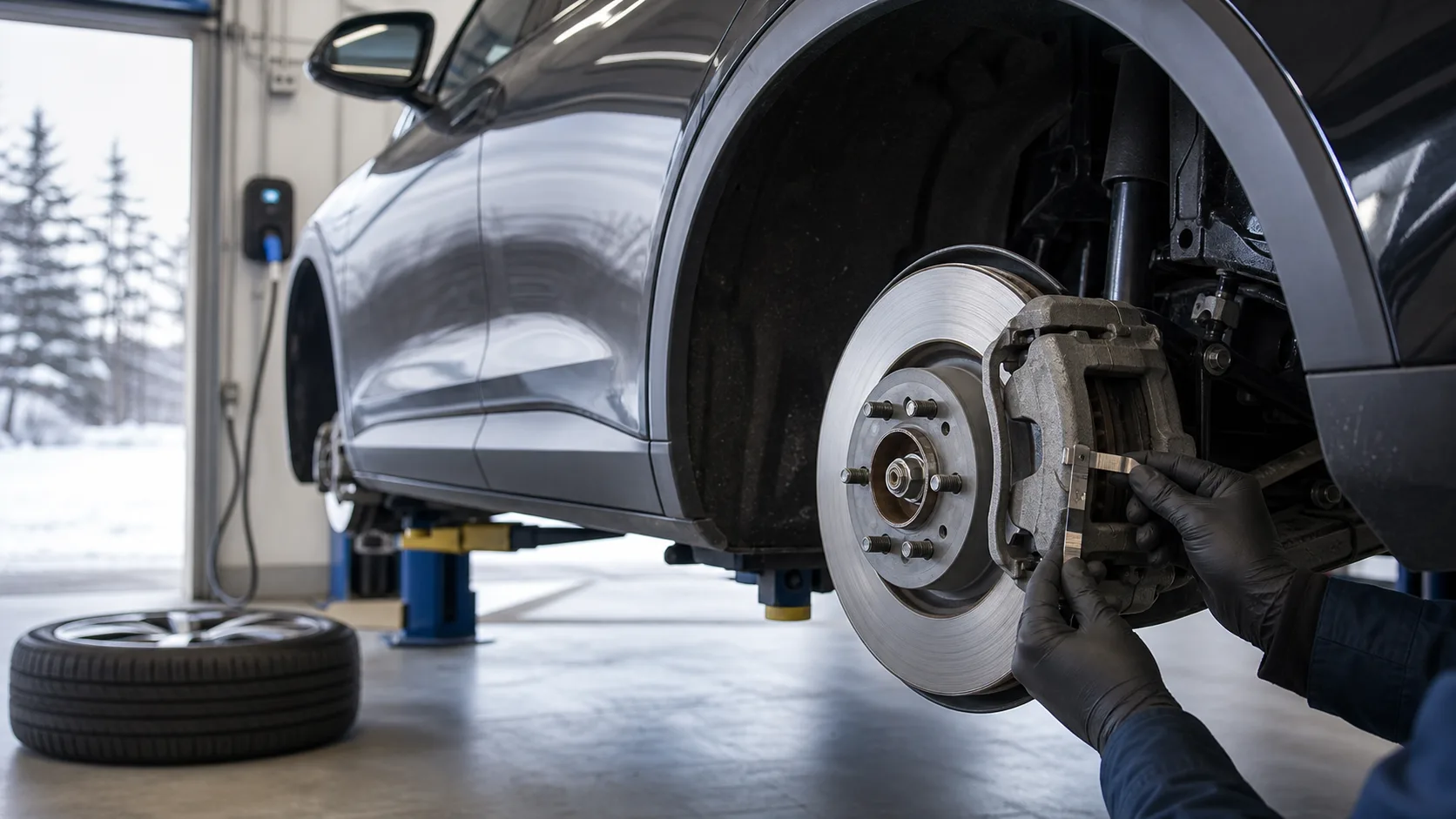
Pads that never press hard never scrub the rust off the rotors, and brine sits on everything from November to April. What fails is the hardware around the pads rather than the pads themselves: caliper slide pins seize, pads bind in their brackets, rotor faces pit outside the narrow band the light braking keeps clean. A seized caliper on one corner drags, wears that pad unevenly, and pulls the car under braking.
Cold makes it worse in a way that surprises new EV owners. When the battery is cold, the vehicle limits how much energy it will accept, so regeneration is reduced or unavailable for the first few kilometres. On a -25°C morning the friction brakes are doing far more of the work than they do in July, on hardware that has been sitting unused.
The fix is not expensive. An annual brake service that pulls the calipers apart, cleans and lubricates the slides and brackets, and checks the rotor surface is what keeps an EV brake system from turning into a parts bill.
Book an EV brake service
Brake hardware cleaning before the salt season
Seized slide pins are cheaper to prevent than a dragging caliper is to replace, so call +1 (825) 221-3120.
Tires wear faster, and weight is the reason
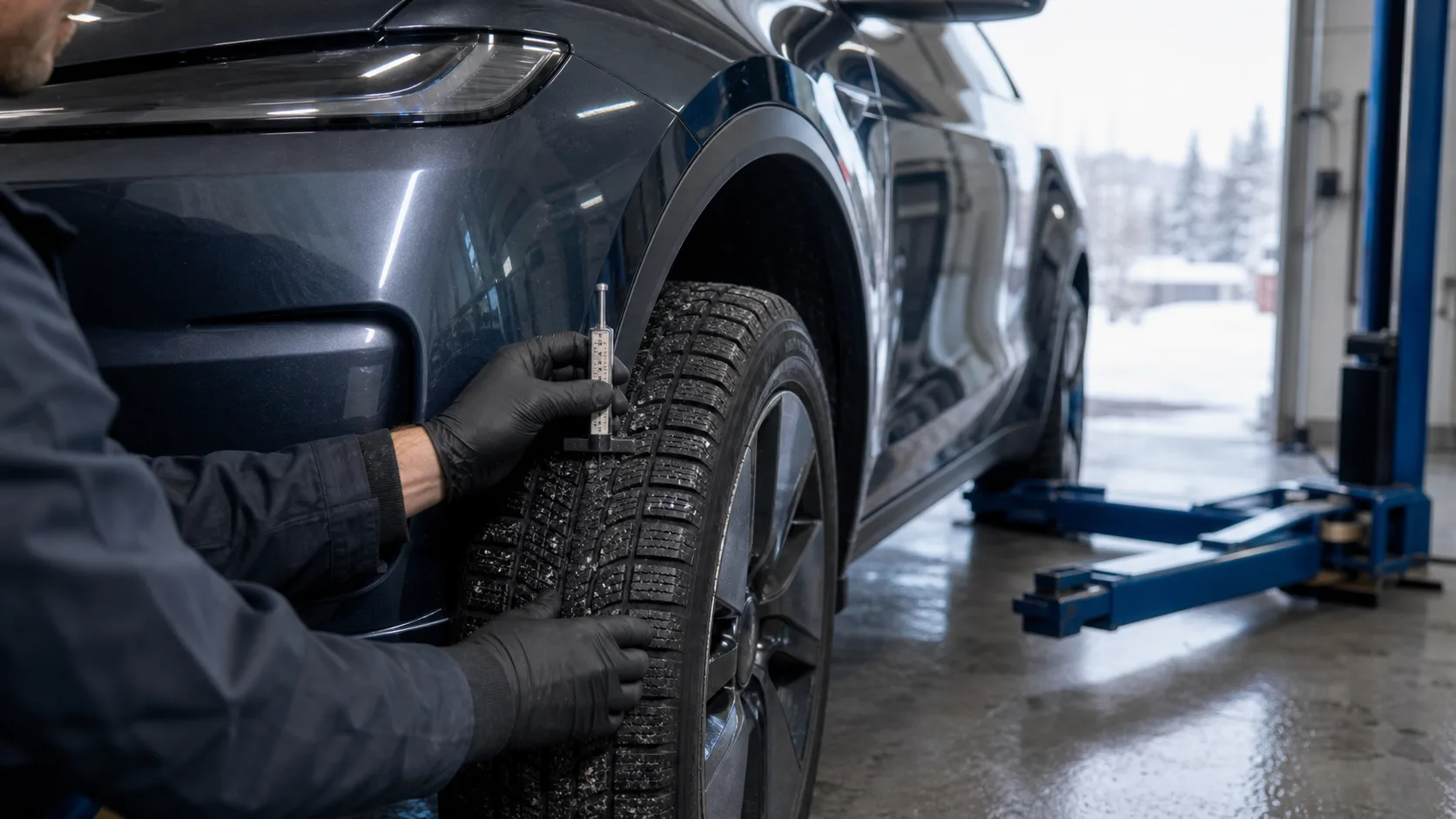
A battery pack adds several hundred kilograms low in the chassis. That mass has to be stopped, turned and accelerated by the same four contact patches, and an electric motor delivers full torque from a standstill instead of building to it. Tires pay for both.
Rotation matters more on an EV than on the gas car it replaced, because uneven wear that used to take 20,000 km to show up arrives sooner and costs more when the tire is a heavier, higher-load-rating unit. Alignment matters more for the same reason. If you commute from Blackfalds or Lacombe down the QEII, or run the arterials like Gaetz Ave and 67 St through pothole season, a heavier vehicle hits those edges harder than a compact sedan does.
Winter tires are not optional on an EV either. Weight does not create grip, and the 7°C compound threshold that governs winter tire changeover applies no matter what turns the wheels.
What still needs servicing on an EV
| Item | Why it still matters | Handled by |
|---|---|---|
| Tire rotation | Weight wears tires faster | Shop |
| Wheel alignment | Harder pothole hits | Shop |
| Brake hardware | Corrosion, not pad wear | Shop |
| Brake fluid | Absorbs moisture over time | Shop |
| Cabin air filter | Same as a gas vehicle | Shop |
| Battery coolant | Not a lifetime fill | Shop |
| 12V battery | Still dies in deep cold | Shop |
| Suspension | More mass, same shocks | Shop |
| Glass and cameras | New glass needs recalibration | Shop |
| HV battery, drive unit | Sealed, warranty work | Dealer |
Winter is the part nobody budgets for
Range is the headline, and the numbers are real. A winter test published by BCAA and CAA on February 10, 2025 drove 13 EVs between Ottawa and Mont-Tremblant at -7°C to -15°C and found they covered 14% to 39% less distance than their official ratings. A Central Alberta January runs well below that test window.
Most of the loss is cabin heat. A gas engine throws away enough waste heat to warm a cabin for free; an electric motor is efficient enough that it does not, so the heat comes out of the same battery that moves the car. Preconditioning while still plugged in shifts that load to the wall instead of the pack.
The 12V battery is the failure that strands people. It runs the computers, the contactors and the door locks, and when it dies the vehicle often will not power up or open its own charge port, even with a full traction battery. Test it in the fall the same way you would on any vehicle, as part of routine maintenance.
Charging density is better here than the national picture suggests: Alberta averages 18 EVs per public charger against 27 nationally, on the same Transport Canada figures. That works in town. It tightens on Highway 11 west toward Sylvan Lake or a QEII run in a cold snap, where a 30% range loss and a heated cabin change the math on whether you stop.
One cost that is not maintenance but lands in the same conversation: Alberta charges $200 per year for each battery electric vehicle, collected at registration or renewal. Hybrids are not charged it.
Glass, cameras, and the bill people do not expect
Rock chips on the QEII do not care what powers the vehicle. What changes is what a windshield costs to put right. EVs lean heavily on camera-based driver assistance, and on most of them the forward camera is mounted to the glass itself.
Replace the windshield and that camera has to be recalibrated to the new glass, or lane keeping, adaptive cruise and automatic emergency braking work from a reference that is off by a fraction of a degree. That is a real procedure with a target and a specification, not a reset button. Budget windshield replacement and ADAS calibration together on any EV, because on most of them the second one is not optional.
Where the dealer is still the answer
Being honest about the boundary: we do not open high-voltage battery packs, service drive unit internals, or work inside inverters and high-voltage cabling. Anything under battery warranty, any recall, and any diagnosis that ends inside the pack belongs at a dealer with the manufacturer’s tooling.
Body damage goes to a body shop, as it does for any vehicle.
That still leaves most of the list. The tires, the brakes, the suspension, the alignment, the fluids, the filters, the glass and the diagnostics are the same trade they have always been.
Getting it done in Red Deer
Bring the EV in and we will do what the gas cars get: tires and rotation, brake hardware cleaned and freed before it seizes, alignment checked after pothole season, 12V battery tested before the first cold snap, and the glass and camera calibration handled together if a chip has spread. Fleet vehicles get the same work on a schedule rather than one call at a time.
Call +1 (825) 221-3120 or come to Bay 5, 7880 48 Ave, Monday to Friday, 08:00 to 17:00. If the problem turns out to be inside the battery pack, we will tell you that plainly and point you at the dealer rather than guess at it.
Frequently asked questions
Do electric vehicles need oil changes?
Not engine oil, because there is no engine. Most EVs still have fluids on a schedule: brake fluid, coolant for the battery and power electronics, and on many models a reduction gear oil. Those intervals are set by time as often as by distance, so check your owner's manual rather than waiting for a reminder that never comes.
Why do EV brakes need service if regenerative braking does most of the stopping?
Because corrosion, not wear, is what usually ends an EV brake job in Alberta. Pads that rarely press hard never scrub the rust off the rotors, and road salt gets into caliper slide pins and pad brackets. The hardware seizes while the pads still have most of their life left. Cleaning and lubricating it is a service visit, not a parts bill.
Do electric vehicles need winter tires in Alberta?
Yes, on the same 7°C rule as any other vehicle. Extra weight does not create grip, and all-season rubber stiffens below 7°C regardless of what drives the wheels. If anything the case is stronger on an EV: more mass means more momentum to stop, and instant torque makes it easier to spin a tire from a standstill on a cold morning.
Does an electric vehicle pay Alberta's $200 electric vehicle tax?
Battery electric vehicles do. Alberta charges $200 per year per battery electric vehicle, collected by registry agents and online when you register or renew. The tax does not apply to hybrids, electric motorcycles or electric off-highway vehicles. Budget it alongside registration, not alongside your service costs.
Can an independent shop service an electric vehicle, or does it have to go to the dealer?
Most of what an EV needs is ordinary mechanical work an independent shop already does: tires, brakes, suspension, alignment, cabin filter, glass and diagnostics. The dealer is the right call for the high-voltage battery pack, the drive unit internals, and anything covered by warranty or a recall.
Does an EV need an out-of-province inspection when I move to Alberta?
Yes. The requirement is tied to where the vehicle was last registered, not to what powers it, so an EV brought in from British Columbia or Ontario goes through the same inspection as a gas vehicle. Mechanical, brake, steering, suspension, tire, lighting and glass items are all checked.