
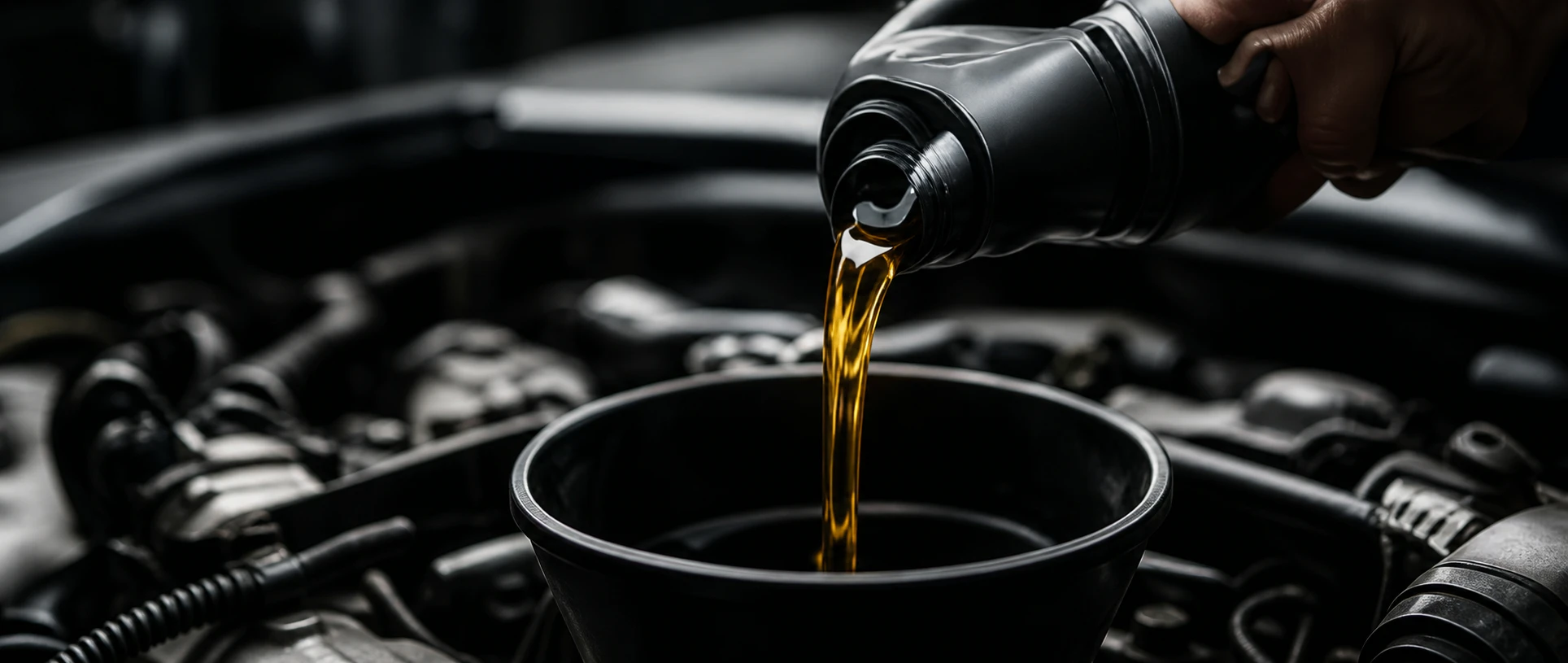
Most manufacturer maintenance schedules run 40+ pages of fine print. Here’s the short version: what actually needs checking or replacing, grouped by how many kilometres are on the odometer.
Every oil change (5,000-12,000 km)
This is the most frequent checkpoint, and the easiest place to catch small problems early since the vehicle is already up on a lift. It covers the oil and filter change itself, a tire pressure and tread check, a look at coolant, brake, and washer fluid levels, and a visual brake inspection.
That pressure check protects more than the tread. Transport Canada reports that operating a vehicle with one tire underinflated by 56 kPa (8 psi) can reduce that tire’s life by 15,000 km and increase the vehicle’s fuel consumption by 4%. See Transport Canada’s tire-pressure guidance, modified December 11, 2013.
Every 20,000-24,000 km
Tire rotation keeps wear even across all four tires. This interval is also when it’s worth inspecting brake pads and rotors more closely, replacing the engine and cabin air filters, and checking the battery’s terminals and charge. If the steering wheel isn’t centred or tires are wearing unevenly, this is a good point to get a wheel alignment checked too. Commuting in from Lacombe or Blackfalds adds kilometres faster than driving around town, so that interval can land sooner on the calendar than the odometer alone suggests.
Book maintenance
Find out what your vehicle is actually due for
Bring in your mileage and we'll match it against your vehicle's actual schedule, not a generic estimate, then call +1 (825) 221-3120.
Every 40,000-60,000 km
Brake fluid absorbs moisture over time and needs replacing on this kind of schedule, even if the pads and rotors are still in good shape. It’s also worth inspecting suspension and steering components and checking belts and hoses for cracking, especially after a few Red Deer winters.
Every 60,000-100,000 km
This is where the bigger-ticket items land: transmission fluid, coolant, and spark plugs, all somewhere in this range depending on the manufacturer’s schedule. If your vehicle has a timing belt rather than a chain, this is also roughly when it needs replacing, and missing that interval risks serious engine damage.
Every 4-5 years, regardless of mileage
Some items are driven by age more than distance. Batteries typically last 4-5 years in this climate and are worth testing annually once they’re past year three. Wiper blades wear out on their own timeline too, often faster than any mileage-based schedule would suggest.
Maintenance schedule at a glance
| Mileage interval | What gets checked or replaced |
|---|---|
| Every oil change (5,000-12,000 km) | Oil and filter, tire pressure and tread, fluid levels, visual brake check |
| Every 20,000-24,000 km | Tire rotation, closer brake inspection, engine and cabin air filters, battery check |
| Every 40,000-60,000 km | Brake fluid, suspension and steering inspection, belts and hoses |
| Every 60,000-100,000 km | Transmission fluid, coolant, spark plugs, timing belt (if equipped) |
| Every 4-5 years, regardless of mileage | Battery test, wiper blade check |
Before winter
A few things are worth checking every fall regardless of where you land on the mileage schedule: switching to winter tires once temperatures consistently drop below 7°C, testing the battery, checking antifreeze concentration, and confirming the heater and defrost are working. If your commute runs out toward Sylvan Lake, that highway stretch tends to hit the 7°C mark before in-town streets do, so it’s worth switching on the early side.
Your owner’s manual still wins
This schedule is a general guideline, not a replacement for your manufacturer’s specific intervals. If you do a lot of short trips, towing, or cold starts, the severe-service schedule in your owner’s manual usually applies instead of the standard one, and it’s often shorter across the board.
Download the checklist
Download the printable vehicle maintenance checklist (PDF) to keep track of what’s due and check items off as you go.
Booking maintenance in Red Deer
Bring your vehicle’s mileage and maintenance history to your next visit at Bay 5, 7880 48 Ave, and we’ll tell you exactly what’s due and what can wait. Book a maintenance visit, and if something else turns up, like a brake or alignment concern, we’ll walk you through it before any work starts.
Frequently asked questions
What maintenance does my vehicle need at every oil change?
This checkpoint exists because it's cheap to combine: the vehicle is already on the lift for the oil change, so a quick look at tires, fluids, and brakes barely adds time. It's the reason most drivers catch a slow leak or a thinning brake pad early instead of after it turns into a bigger repair.
What should be checked around 20,000 to 24,000 km?
Skipping this interval is where uneven tire wear starts compounding: a rotation now evens it out, and putting it off makes the wear pattern harder to correct later. Air filters and the battery get checked at the same visit mainly because they're due around the same mileage, not because they're related to the tires.
When should I replace transmission fluid and coolant?
Most manufacturers call for transmission fluid and coolant somewhere between 60,000 and 100,000 km, though it varies by vehicle. Check your owner's manual for the exact interval, since some modern transmissions use longer-life fluid. Spark plugs usually land in that same window too, which makes it worth treating as one visit rather than three separate trips to the shop.
Do all vehicles have a timing belt to worry about?
No. Many newer engines run a timing chain, which usually lasts the engine's life without a scheduled swap. A timing belt is the one on a fixed interval, and it isn't always obvious from the outside which one your engine has. Your owner's manual or a VIN lookup will tell you, and it's worth checking before that mileage range arrives rather than after.
Is this schedule the same for every vehicle?
Only as a starting point. Manufacturers set two schedules, standard and severe-service, and plenty of Red Deer drivers doing winter commuting, short in-town trips, or occasional towing fall under severe-service without realizing it. That version is almost always shorter, so check which category your driving pattern fits before assuming the standard intervals apply.
Is there a printable version of this checklist?
Yes, there's a free downloadable PDF checklist at the end of this guide covering every interval mentioned here, from oil changes through the 100,000 km services. It's built around these general mileage intervals, not your specific manufacturer schedule or the severe-service version, so treat it as a tracking tool alongside your owner's manual rather than a replacement for it.